If your home is in Fernandina Beach, on Amelia Island, near the Intracoastal, or anywhere in Nassau County within a few miles of tidal or ocean water, the material your gutters are made of matters more than it does for most Florida homeowners.
Salt air does real damage to metal systems over time. The question is which metals hold up and which ones do not, and what the practical and financial differences are between your options. Few things are more frustrating than paying for new gutters and watching rust streaks show up a few years later. After 40-plus years of installing gutters on coastal Nassau County properties, here is our honest comparison.
Why Coastal Florida Is Different From the Rest of the State
Florida in general is a demanding environment for exterior systems. Coastal Florida is a different category again. The combination of factors that coastal Nassau County properties face is genuinely harsh:
- Salt air. Airborne salt particles from the ocean and Intracoastal deposit on all exterior surfaces continuously. The closer to the water, the higher the concentration.
- High humidity. Nassau County’s coastal humidity accelerates the corrosion process that salt starts. Moisture in the air is the catalyst that turns salt on metal surfaces into active corrosion.
- UV radiation. Florida’s UV index is among the highest in the continental United States. UV degrades sealants and coatings that protect metal surfaces.
- Hurricane exposure. High-wind events bring salt-laden air well inland and accelerate the corrosion of any hardware that was borderline before the storm. See our guide on how hurricane season destroys your gutters for what that looks like in practice.
Any gutter system installed on a coastal Nassau County property needs to be specified with these conditions in mind. A system that would last 25 years in inland Florida may last 10 years near the Amelia Island coast if the wrong materials are used.
Aluminum Gutters in Coastal Florida
Aluminum is the right choice for most Nassau County homes, including most coastal properties. Here is why and where it works well.
What Aluminum Does Well Near the Coast
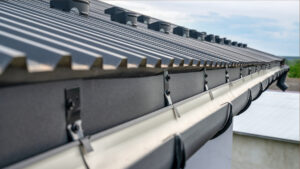
Aluminum does not rust. Unlike steel, it forms a thin protective oxide layer rather than corroding in the same way when exposed to salt air and moisture. The aluminum itself is stable in coastal environments. A quality seamless aluminum gutter on a Nassau County coastal property will outlast a steel gutter significantly.
Where the Specifications Matter
The vulnerability in aluminum gutter systems on coastal properties is not the aluminum itself. It is everything else: the fasteners, the sealant at the joints, and the hardware connecting the system to the fascia.
Standard residential gutter hardware uses zinc-coated steel fasteners. Zinc-coated steel can corrode in salt air within just a few seasons in coastal environments. Once the fastener corrodes, the gutter section it is holding begins to pull away from the fascia, regardless of how well the aluminum itself is holding up. If you are already noticing sagging or pulling away, these 5 signs your gutters are failing are worth a look.
For Nassau County coastal properties, we specify coated or stainless steel fasteners and marine-grade UV-stable sealant as standard. Not as an upgrade. As the baseline specification. The aluminum is heavier-gauge than standard residential gutter aluminum, which adds durability in high-wind events.
When Aluminum Is the Right Answer
For most coastal Nassau County properties, properly specified aluminum seamless gutters are the correct choice. They perform well, cost less than copper, and when installed with the right hardware they last 20 to 30 years in the coastal environment.
Copper Gutters in Coastal Florida
Copper is the premium option for coastal properties, and on certain homes it is genuinely the best long-term choice.
Why Copper Works in Salt Air
Copper is highly resistant to salt-air corrosion. The patina that copper develops over time is not evidence of failure. It is a protective layer that forms on the copper surface and slows further oxidation. A copper gutter system on an Amelia Island oceanfront property will typically outlast an aluminum system installed in the same location.
The Lifespan Argument
Copper gutters on coastal Florida properties can realistically last 50 years or more. They need little maintenance beyond regular cleaning, and they never rust. They develop a beautiful weathered appearance that complements the historic and premium aesthetic of many Amelia Island and Fernandina Beach properties. This Old House’s copper gutter guide explains how the patina forms and why it can develop faster along seacoasts.
One important detail: copper systems should be fastened with copper or stainless steel hardware. Mixing in aluminum nails or patches triggers galvanic corrosion, which damages the metals over time.
The Cost Argument
Copper costs roughly three to five times more per linear foot installed than aluminum. On a typical Nassau County home, a full copper gutter installation commonly runs between $4,000 and $10,000 depending on the property size. That is a significant upfront investment.
The financial case for copper is strongest for: oceanfront or Intracoastal properties with the highest salt exposure, older homes where the owner plans to be in the home long-term, and historic properties where the aesthetic of aged copper fits the character of the architecture.
If you are also planning a metal roof, it is worth choosing materials together, since copper runoff can stain or corrode certain other metals below it. Our metal roofing team can help you plan the whole system.
Steel Gutters Near the Coast
We do not recommend steel gutters for coastal Nassau County properties. Standard galvanized steel gutters rust in the coastal environment faster than most homeowners expect. We see steel gutter systems on Amelia Island and Fernandina Beach properties that are 8 to 12 years old with significant corrosion at the seams and fastener points.
Steel gutters may be appropriate for inland Nassau County properties where salt-air exposure is minimal. For anything within a few miles of the coast or the Intracoastal Waterway, aluminum or copper is the right choice.
Our Recommendation for Nassau County Coastal Homeowners
For most Nassau County coastal properties: heavy-gauge seamless aluminum with stainless or coated fasteners and marine-grade sealant. This is the right balance of performance and cost for the majority of homes in this area. Our seamless gutter installation and repair service is built around exactly this specification.
For properties with the highest salt exposure, oceanfront locations, or homeowners who want a system they will never have to replace: copper gutters are worth the premium investment.
For inland Nassau County properties with limited coastal exposure: standard aluminum with normal residential hardware specifications is adequate and cost-effective.
Three Questions to Ask Any Gutter Contractor Near the Coast
- What are the fasteners made of? Stainless or coated fasteners hold up far better in salt air than standard zinc-coated steel.
- What gauge is the aluminum? Heavier gauge resists wind loads and holds its shape longer.
- What sealant is used at the joints? Look for a marine-grade, UV-stable product, not a basic hardware store caulk.
Ask Us What Gutter Material Is Right for Your Nassau County Home
Not sure which option fits your property? Request a free estimate or call LePierre Roofing at (904) 277-3000 for a free consultation. License No. CCC1326391. You can see every community we serve on our service areas page.
Frequently Asked Questions
What is the best gutter material for homes near the Florida coast?
For most coastal Nassau County properties, heavy-gauge seamless aluminum with stainless or coated fasteners and marine-grade sealant is the right choice: good corrosion resistance, 20 to 30 year lifespan when properly specified, and reasonable cost. For properties with the highest salt exposure, oceanfront locations on Amelia Island, or homes where a 50-plus year lifespan justifies the upfront cost, copper is the premium long-term solution.
Do aluminum gutters rust in Florida salt air?
Aluminum itself does not rust in salt air the way steel does. The vulnerability is in the hardware: standard zinc-coated steel fasteners can corrode in coastal environments within a few years. For coastal Nassau County properties, we specify stainless or coated fasteners as standard, which addresses the main failure point and allows aluminum gutters to perform reliably for 20 to 30 years near the coast.
How long do copper gutters last in coastal Florida?
Copper gutters on coastal Florida properties can realistically last 50 years or more. Copper develops a protective patina over time that slows further oxidation. It is highly resistant to the salt-air corrosion that shortens the lifespan of steel systems and affects aluminum hardware in coastal environments. The lifespan advantage is the primary argument for the higher upfront cost of copper on oceanfront and Intracoastal properties.
Are copper gutters worth the cost in coastal Florida?
For properties with the highest salt exposure and for homeowners planning to be in the home long-term, copper gutters are worth the cost. The lifespan advantage over properly specified aluminum is most pronounced at the extreme coastal end of Nassau County’s range of properties. For properties a mile or more from the ocean or Intracoastal, the cost-benefit calculation is less clear and heavy-gauge aluminum is often the more practical choice.
Do steel gutters corrode faster than aluminum in Florida?
Yes, significantly. Standard galvanized steel gutters corrode in coastal Florida environments at a rate that can produce visible rust and joint failures within 8 to 12 years near the coast. Aluminum does not corrode in the same way. For any Nassau County property near the ocean or Intracoastal Waterway, steel gutters are not an appropriate specification. Aluminum or copper are the correct material choices.
What gauge aluminum gutters are best for coastal Florida homes?
Heavier-gauge aluminum, typically 0.032 inch rather than the standard residential 0.027 inch, is the right specification for coastal Nassau County properties. The heavier gauge provides better resistance to the wind loads common during storm events and better dimensional stability over the lifespan of the system. We specify heavier gauge aluminum as standard on all coastal installation jobs.
LePierre Roofing | (904) 277-3000 | lepierreroofing.com | License No. CCC1326391 | Nassau County, FL